Healthcare · FPM Briefing
Medicare Proposes 2027 Physician Pay Cut as Temporary Increase Expires
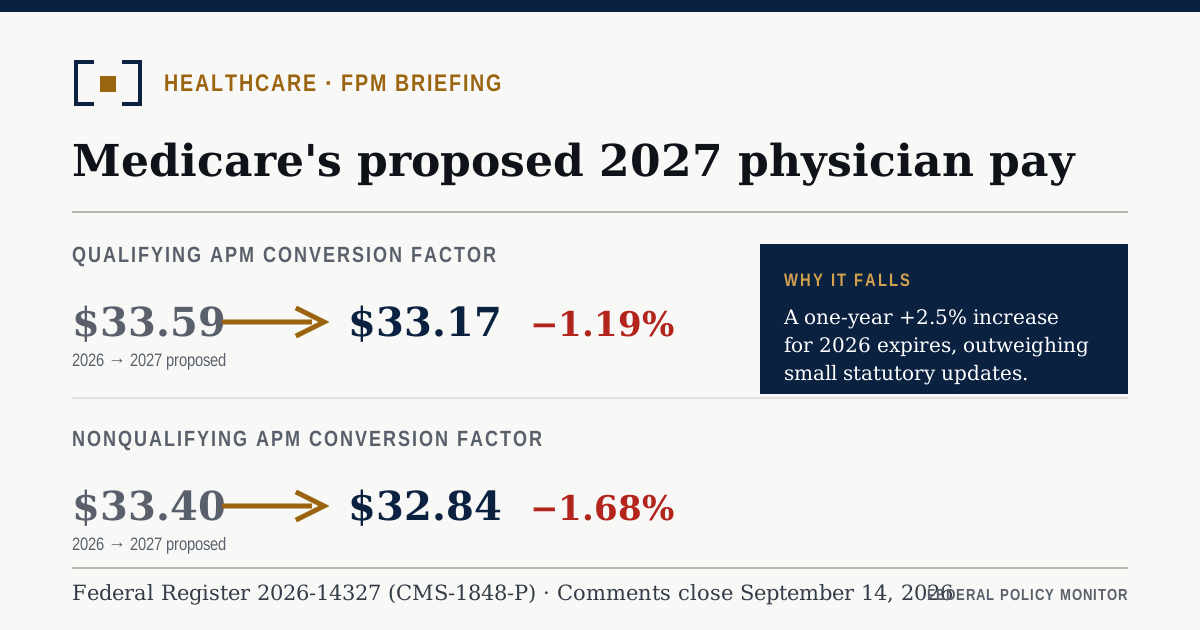
The Centers for Medicare & Medicaid Services has proposed the calendar-year 2027 Medicare Physician Fee Schedule, and under it physician payment rates would fall relative to 2026. Both of the two conversion factors set in current law would drop — the qualifying-APM factor from $33.59 to $33.17 (−1.19%) and the nonqualifying-APM factor from $33.40 to $32.84 (−1.68%) — chiefly because a one-year 2.5% increase provided for 2026 expires, outweighing smaller statutory updates. The rule is proposed, not final, and is open for public comment through September 14, 2026.
Medicare has proposed how it will pay physicians in 2027, and the headline number moves in the direction doctors dread: down. In the calendar-year 2027 Physician Fee Schedule proposed rule, the Centers for Medicare & Medicaid Services would lower the payment rates that convert medical services into dollars. But the reasons are more specific — and more procedural — than a simple across-the-board cut, and the details are what determine who is affected and by how much.
How to read this report
OFFICIAL FACT — CMS published this proposed rule (Federal Register document 2026-14327, CMS-1848-P) on July 16, 2026, and comments are due by September 14, 2026. PROPOSED POLICY — the payment rates and changes below are proposals CMS can revise before any final rule. FPM ANALYSIS — labeled where it appears, and reflects Federal Policy Monitor's interpretation, not the government's.
What CMS is proposing
The Physician Fee Schedule is the annual rule that sets what Medicare pays clinicians for tens of thousands of services, from an office visit to a surgical procedure. Payment for a given service is, in simplified terms, the service's relative value multiplied by a dollar figure called the conversion factor. CMS proposes the CY2027 conversion factors, updates the relative values behind many services, and — as it does every year — folds in a wide range of other Part B payment and policy changes, along with updates to the Quality Payment Program that governs how clinicians are scored on cost and quality.
Two conversion factors, both lower
Since 2026, federal law sets not one conversion factor but two: a higher one for clinicians who qualify as participants in advanced alternative payment models, and a lower one for everyone else. CMS proposes both would decline for 2027. The qualifying-APM conversion factor would fall from $33.5875 to $33.1693 — about $33.17, a decrease of 1.19%. The nonqualifying conversion factor would fall from $33.4009 to $32.8409 — about $32.84, down 1.68%.
The decline is not, for the most part, a new cut. By CMS's own accounting, the dominant reason the 2027 figures are lower is that a one-year 2.5% increase Congress provided for 2026 — enacted in Public Law 119-21 — expires at the end of the year. Working against that expiration are smaller upward forces: a recurring statutory update of 0.75% for the qualifying factor and 0.25% for the other, plus a 0.53% budget-neutrality adjustment tied to proposed changes in service values. The net effect is a decrease compared with 2026.
A separate efficiency adjustment
The conversion factor is not the only lever moving rates. CMS would continue an “efficiency adjustment” it established for 2026, reducing the work relative value units and physician-time assumptions for many services that are not time-based, by 2.5%. This is distinct from the conversion-factor math above: it changes the value assigned to particular services rather than the dollar multiplier applied to all of them. Time-based services, telehealth services, and new or recently revalued codes are exempt from it.
Beyond the pay rate: other major proposals
The rule is far larger than its conversion factors. Among the most consequential proposals: CMS would convert the G2211 “visit complexity” add-on into a modifier that raises the associated evaluation-and-management payment by 16%; it would reduce payment when a separately identifiable E/M visit is furnished on the same day as a procedure carrying a global-surgery period, paying the most expensive service in full and others at 50%; and it would begin phasing out the parts of its practice-expense methodology that still rely on survey data from 2007 or earlier. On behavioral health, CMS proposes higher work values for psychotherapy services, phased in over several years, and would extend the ability to furnish behavioral-health services via telecommunications technology through December 31, 2027. The rule also carries updates to the Quality Payment Program, the Medicare Shared Savings Program, remote-monitoring requirements, and the Medicare drug inflation rebate program.
The September 14 comment deadline
Comments are due by September 14, 2026. The proposed rule was published in the Federal Register on July 16, 2026 (document 2026-14327, CMS-1848-P) under regulatory identifier 0938-AV82, and comments are submitted through the regulations.gov docket, CMS-2026-2377. For medical specialty societies, health systems, and the group-practice and government-affairs teams that track physician payment, that window is the formal opportunity to influence what CMS finalizes — on the conversion factor, on G2211, on the global-period change, and on the practice-expense overhaul.
What is proposed versus final
None of this is in effect. These are proposals subject to public comment, and CMS routinely revises figures — including the conversion factors — between the proposed and final rules, partly because some inputs are updated with newer data. Congress can also act separately to change the payment update, as it did for 2026. The July 16 publication, the September 14 deadline, and the document, docket, and rule identifiers are established facts; the specific rates and policies are what CMS has put forward for comment.
Federal Policy Monitor analysis
FPM analysis: the politically potent line — a Medicare physician pay cut — is real but needs the asterisk that most of it is a lapse, not a fresh reduction. The temporary 2026 bump was always scheduled to end, and the recurring statutory updates that replace it are small by design. That framing matters for the comment period, because the fixable pieces are elsewhere: the efficiency adjustment, the global-period E/M change, and the practice-expense methodology will redistribute money among specialties in ways the top-line conversion factor obscures. The two-conversion-factor structure also quietly rewards clinicians who clear the advanced-APM threshold — a standing incentive that this rule, again, leaves in place. For anyone filing comments, the specialty-level redistribution is where the real stakes sit, not the single number in the headline.
Sources
- [1] CY 2027 Physician Fee Schedule Proposed Rule (CMS-1848-P, RIN 0938-AV82) — Federal Register (HHS / Centers for Medicare & Medicaid Services)
- [2] CY 2027 Medicare Physician Fee Schedule Proposed Rule (fact sheet) — Centers for Medicare & Medicaid Services
- [3] Comment on the proposed rule (docket CMS-2026-2377) — Regulations.gov